

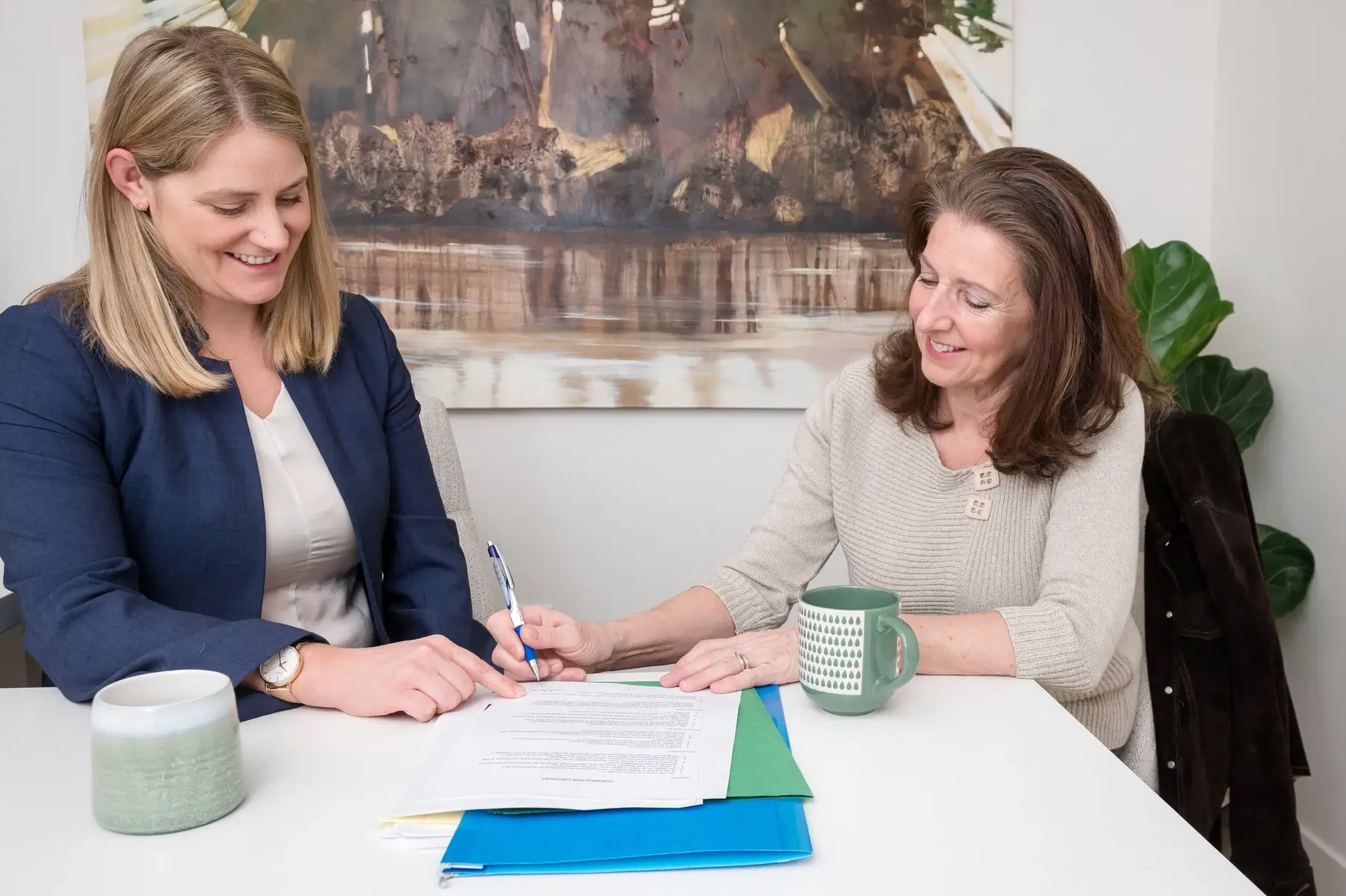
Family Mediation in the Comox Valley
A calmer way through separation
You don’t have to turn your separation into a battle. With family mediation, you and the other person work out your own agreement — on parenting, support, and property — with the help of a neutral, trained mediator, instead of handing those decisions to a judge. It’s usually faster, far less expensive, and a great deal less stressful than going to court. Most of all, it lets you protect the relationship you’ll still need for years of co-parenting ahead.
We’re Coastal Family Law & Mediation, here in Comox, serving families across the Comox Valley — Courtenay, Comox, Cumberland and beyond.
Book a free 15-minute call
No preparation needed, no obligation.
Or call us at 250-940-2197
What family mediation actually is
Family mediation is a voluntary, confidential process. A neutral mediator — someone who doesn’t take sides — sits down with both of you, helps you understand your options, and guides the conversation so the two of you can reach your own agreement. The mediator doesn’t decide anything for you and doesn’t take anyone’s side. You stay in control of the outcome.
That’s the key difference from going to court. In litigation, you each hire lawyers to argue your case, and a judge who has only just met your family makes the final decisions. It’s adversarial by design, it’s a matter of public record, and in British Columbia a contested family file commonly runs $25,000 to $100,000 or more per person and takes six months to three years or longer.
Mediation flips that. You keep the decisions, the conversations stay private, the cost is a fraction of litigation, and — because you built the agreement together — it tends to hold up far better over time. For families who’ll keep sharing a calendar and a couple of kids long after the paperwork is signed, that preserved relationship may be the most valuable part of all.
What can be resolved through mediation
Mediation can address the main issues that come up when a relationship ends, all under British Columbia’s Family Law Act (the provincial law that governs family matters).
Parenting arrangements and time with children
Where the children live, how time is shared, how you’ll make decisions together, holidays, school, travel, and the day-to-day logistics of raising kids across two homes.
Download our helpful guide Parenting Arrangements.
Child support and spousal support
What support looks like, based on the Federal Child Support Guidelines and each family’s circumstances. We prepare clear support calculations so you’re working from real numbers, not guesses.
Dividing property and debt
Your home, vehicles, savings, pensions, businesses, and the debts that come with them—sorted into a clear Property & Debt Schedule so everyone can see the full picture.
Whether you’re married or common-law, the Family Law Act applies to you—and so does mediation. We welcome all families, including LGBTQ2S+ couples and common-law partners.
The process — what to expect
One of the hardest parts of separation is not knowing what comes next. Here’s the path, step by step, so there are no surprises.
Want a detailed walkthrough of each phase? See our Mediation Roadmap.
1. First contact — a free 15-minute call
A relaxed, no-obligation conversation. No preparation needed. We learn a little about your situation and help you figure out whether mediation — or another option — is the right fit.
2. Intake and screening
We meet separately with each of you for a pre-mediation meeting to understand your goals and answer your questions. As part of this, we screen for family violence and check that mediation is appropriate and safe for your situation — this is required by law and it protects everyone involved.
3. Information gathering
We send a financial questionnaire and a document checklist, then prepare a Property & Debt Schedule and support calculations so you both walk in working from the same clear, complete picture.
4. Joint mediation sessions
You and the other person meet with the mediator to work through parenting, support, and property. The agenda goes out ahead of time, and tentative agreements are written down as you go. Our package includes up to 10 hours of session time, which can be split in whatever way works best for your family.
5. Drafting the agreement
The mediator prepares a draft separation agreement. You’re each encouraged to get independent legal advice — that simply means your own lawyer reviewing it for you — before anything is signed.
6. Finalizing and next steps
Once you’re both satisfied, you sign with a witness, and we give you clear instructions for putting the plan into action — things like transferring assets and updating beneficiaries — so you can move forward with confidence.
Why work with us
We are lawyers and accredited mediators. As accredited mediators we lawyers who are qualifies under the rules of the Law Society of British Columbia to act as a family law mediator and can bring our legal experience to this role.
A qualified family mediator
Our principal, Laura Atkinson, is a lawyer who is qualified under the Rules of the Law Society of British Columbia to act as a family law mediator, with experience in family law.
A focus on mediation, not court
We believe court should be a last resort. Our practice is built around resolving family matters outside the courtroom — and if a file ever does need to go to trial, we help you transition to trial counsel rather than leaving you on your own.
A compassionate, forward-focused philosophy
Our whole approach is built on the idea that separation can be a point of positive transition rather than a messy divorce. We’re competent, we’re compassionate, and we’ll always be straight with you.
A genuine local team
Lawyers, a mediator, and designated paralegals who care about helping families through a hard chapter — based right here in the Comox Valley.
Pre-Mediation Meeting
This meeting is not a sales pitch. Sometimes we finish a pre-mediation meeting and tell someone that mediation is not the right process for them right now. We would rather say that at the start than partway through. There is no pressure you proceed with mediation.
Regardless of whether you proceed with mediation after this meeting – you will receive useful legal information and a checklist to help you in your family law matter.
If after the pre-mediation meetings you and your spouse want to proceed, we will recommend a tier based on your family’s needs and you can decide whether to move forward.
Pre-Mediation Meeting
$300 per person (with tax $336)
Before any mediation begins, we meet with each of you separately for about 45 minutes. This meeting is where we:
- Talk through what matters most to you and what you hope your life looks like on the other side of this
- Walk you through how mediation works, step by step, so there are no surprises
- Complete our family violence screening, which we are required by law to do
- Answer your questions honestly, including questions about cost and timing
- Help you decide whether mediation is genuinely the right fit for your situation
The Three Mediation Tiers
| Tier 1 — Essential | Tier 2 — Extended | Tier 3 — Complex | |
|---|---|---|---|
| Fee per person | $2,500 + tax | $3,750 + tax | $5,000 + tax |
| Total with 12% tax | $2,800 | $4,200 | $5,600 |
| Mediation time included | The Core Package plus up to 4 hours of mediation | The Core Package plus up to 8 hours of mediation | The Core Package plus up to 12 hours of mediation |
| Typical fit | Broad agreement, straightforward finances, documents readily available | Some unresolved issues, or finances that take longer to sort out | Higher conflict, business or self-employment income, or financial information that is incomplete or hard to obtain |
Your mediation hours do not have to be used in one sitting. They can be split across a few days, and it is very common to hold an initial session and then a follow-up session within the same tier.
What Every Tier Includes – The Core Package
You are not paying separately for phone calls, emails, or the preparation work behind the scenes. It is one fee per person.
Whichever tier fits your file, your fee covers:
- All communication with our office to prepare for mediation — you are not billed each time you email us a question
- Document collection and organisation — we provide the checklist, review what you send, and tell you what is still missing
- Preparation of your property and debt schedule and, where applicable, child and spousal support calculations
- The mediation session itself, up to the hours included in your tier
- Drafting the outcome of your mediation — usually a Separation Agreement
- Basic revisions to that draft
Choosing a Tier
We will recommend a tier after the pre-mediation meetings, because that is the first point at which we have enough information to make a sensible estimate. Four things tend to drive how much time a file needs.
None of these make you a difficult client. They are simply features of a file, and we would rather price them honestly than pretend every mediation takes the same amount of time.
1. The level of conflict and disagreement between you
Two people who are hurt or angry but able to stay at the table can move quickly. Two people who need to revisit their history before discussing the future will need more hours.
2. The complexity of your finances
A house, a mortgage, and two pensions is straightforward. Add a business, a rental property or exclusions and there is more to work through.
3. Business ownership or self-employment
Determining income for support purposes is more involved when income comes from a business rather than a T4, and property division may involve valuing the business itself.
4. The reliability and availability of your financial information
This is the factor people underestimate most. When documents are missing, out of date, or slow to arrive, mediation time gets spent tracking down information instead of resolving issues.
How You Can Keep Your Costs Down
You have more influence over your final cost than you might think. The clients who finish comfortably within their tier tend to do these things.
- Send your documents early and completely. This is the single biggest cost factor within your control. Working from a complete financial picture means we can spend session time on decisions rather than on gaps.
- Tell us early if something will be hard to get. A pension valuation or a business financial statement can take weeks to obtain. If we know at the start, we can work around the timing. If we find out the week before mediation, we may need to reschedule.
- Come with your priorities sorted, not your position locked. Knowing what matters most to you is enormously helpful. Arriving with a single non-negotiable outcome usually costs time rather than saving it.
- Keep communication between you businesslike. Short, factual, child-focused messages between sessions keep the temperature down. Long messages about the past tend to raise it, and a higher temperature costs hours.
- Choose your battles. Every issue you resolve between yourselves before mediation is time you do not spend on it in the room. Many couples arrive having already agreed on things like which household items go where.
- Arrange your independent legal advice promptly. We encourage each of you to have your draft agreement reviewed by your own lawyer. Booking that review early keeps your file moving.
- Use the process for the hard conversations, not the small ones. Mediation is designed for the genuinely difficult issues. Save your hours for those.
If Your File Needs More Time
Sometimes a file turns out to be more involved than it first appeared. If that happens, we will tell you before you run out of hours, not after — and we will explain what we think is still needed and roughly how long it will take.
At that point you can add session time at our hourly rate ($250.00 per person), or move up to the next tier, whichever works out better for you. You will always know the cost before we proceed.
If mediation stops working for you, you are free to step out at any point. Mediation is voluntary from beginning to end.
What is Not Included
If we think your file will need any of these, we will flag it early so you can budget for it.
To be completely clear, the following are separate costs:
- Independent legal advice from your own lawyer on the draft agreement (we encourage this; it is not mandatory)
- Third-party reports such as business valuations, property appraisals, pension valuations, or actuarial reports
- Court filings or applications, if your agreement requires a court order
- Wills and estate planning updates after your agreement is signed (we can help with this separately, and we recommend it)
A Note on Our Role
As mediators as also lawyers, but as your mediator we do not act for either of you and cannot tell you what you should do. Our role is to guide the conversation, provide information, help you explore options you may not have considered, and record what you agree. The decisions are yours. That is the whole point.
Frequently asked questions
How long does family mediation take?
Most mediations complete in about six to ten weeks, depending on how quickly information is gathered and how many issues need to be worked through. A contested court process, by contrast, often takes six months to three years or more.
Do we each need our own lawyer?
You’re not required to have a lawyer, but we strongly encourage each of you to get independent legal advice — your own lawyer reviewing the agreement for you — before signing. Mediation doesn’t replace legal advice; it gives you a calmer, less expensive way to actually reach an agreement.
Is a mediated agreement legally binding?
Yes. Once both people sign a separation agreement with a witness, it is an enforceable contract under BC’s Family Law Act, and it can be filed with the court to be incorporated into a court order if needed.
What if we can’t agree on everything?
That’s normal, and it’s exactly what the mediator is there for. You don’t need to agree before you start. The mediator helps you explore options and find common ground, and you can resolve some issues while narrowing others. You’re never locked in — mediation is voluntary, and you can step away at any point before signing.
Is mediation confidential?
Yes. Mediation conversations, emails, and notes are confidential and treated as “without prejudice” settlement discussions, which means they generally can’t be used as evidence in court. There are limited legal exceptions, such as a mediator’s duty to report if a child may be in need of protection.
How much does mediation cost?
Our comprehensive package is $5,000 per person, plus tax, covering the entire process from intake to implementation. A flexible pay-by-phase option is also available at $5,500 per person, plus tax. Both cost far less than a contested court file.
Can we use mediation if we’re common-law and not married?
Yes. BC’s Family Law Act applies to both married and common-law couples, and mediation is available to you the same way. We welcome all families, including LGBTQ2S+ couples.
What if there’s been family violence or things feel one-sided?
We screen every file for safety and for a significant power imbalance before we begin, because mediation isn’t appropriate in every situation. If it isn’t the right fit, we’ll tell you honestly and help you understand your other options. Your safety comes first.
What happens on the free 15-minute call?
It’s a relaxed, no-pressure conversation. You don’t need to prepare anything. We’ll learn a little about your situation, answer your initial questions, and help you figure out whether mediation is the right path for your family.
Where are you located, and do you offer remote sessions?
Our office is in Comox, and we work with families throughout the Comox Valley, including Courtenay and Cumberland. Sessions can be held in person or by secure video conference, whichever works best for you.